
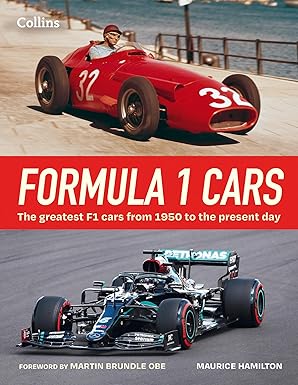
Description
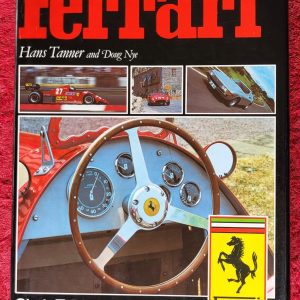
Since the inaugural World Championship season in 1950, Formula 1 cars have represented the pinnacle of automotive innovation, blending aerodynamics, materials science, and engine technology. Several machines stand out not just for championship success, but for the ways they reshaped the sport. This is all detailed in “
1950s — Alfa Romeo 158/159 The dominant early F1 car was the Alfa Romeo 158/159 “Alfetta.” With a supercharged straight-eight engine, it combined raw power and reliability to win early championships. Its success established F1 as a technical competition and set engineering benchmarks for years to come.
1960s — Lotus 25 Colin Chapman’s revolutionary Lotus 25 introduced the monocoque chassis in 1962, dramatically improving stiffness and safety while cutting weight. Jim Clark piloted it to multiple victories, and the car’s structural innovation changed race car design forever.
1970s — Ferrari 312T The Ferrari 312T series, beginning in 1975, combined a flat-12 engine with superb handling balance. Niki Lauda’s 1975 championship highlighted Ferrari’s engineering excellence. The 312T’s transverse gearbox and aerodynamic refinement influenced team design philosophies into the next decade.
1980s — McLaren MP4/4 Dominance defines the McLaren MP4/4. Designed by Gordon Murray and Steve Nichols and powered by a Honda V6 turbo, it won 15 of 16 races in 1988, with Ayrton Senna and Alain Prost at the wheel. Its low-slung profile and efficient packaging represent peak turbo-era engineering.
1990s — Williams FW14B Active suspension, semi-automatic gearbox, and advanced aerodynamics made the Williams FW14B a technological marvel in 1992. Driven by Nigel Mansell, it demonstrated how electronics and systems integration could deliver a competitive edge—prompting regulatory scrutiny and future bans on some active aids.
2000s — Ferrari F2004 The Ferrari F2004 is often cited as one of the most complete F1 cars: dominant aerodynamics, a potent V10, superb reliability, and Michael Schumacher’s masterful driving yielded 15 wins in 18 races. Its combination of speed and balance made it a benchmark for excellence.
2010s — Red Bull RB7/RB9 Adrian Newey’s Red Bull designs, particularly the RB7 (2011) and RB9 (2013), leveraged aerodynamic expertise and innovative ride-height and downforce concepts. Sebastian Vettel’s championships illustrated the power of cohesive design and team execution.
2020s — Mercedes W11 Mercedes’ hybrid era dominance peaked with the W11 in 2020. The integration of a powerful hybrid power unit, sophisticated aerodynamics, and fine-tuned driver aids produced consistent performance and reliability, securing yet another championship in a longer legacy.
Conclusion Greatest F1 cars, are more than winners; they are milestones in engineering. From the Alfetta’s brute force to today’s hybrid masterpieces, each epoch’s standout car pushed technology forward and rewrote what’s possible on the racetrack.

Reviews
There are no reviews yet.